

By Kudzai Jakachira


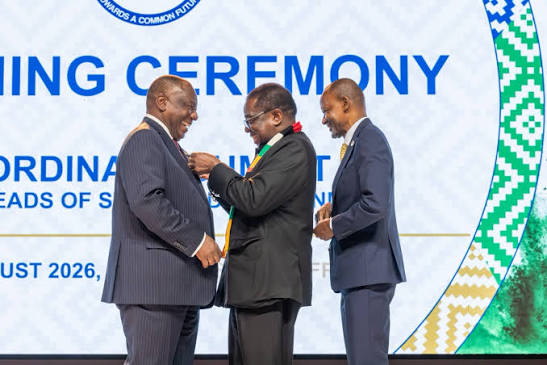
HARARE — With South Africa formally assuming the leadership of the Southern African Development Community (SADC), pressure is intensifying on President Cyril Ramaphosa to confront the regional governance failures driving persistent cross-border migration.
The transition removes a key diplomatic buffer for Pretoria, effectively ending long-standing arguments that frame the country’s immigration challenges purely as a localised border-enforcement issue along the Limpopo River.
Political analysts and regional policy experts contend that South Africa cannot sustainably resolve migration pressures through police operations, mass deportations or political rhetoric regarding undocumented foreign nationals. Instead, they argue, a lasting solution requires confronting the structural conditions driving displacement from countries such as Malawi, Zimbabwe and Mozambique.
“Treating regional migration purely as a policing problem at the border ignores the underlying political drivers,” observed senior regional political analysts. “South Africa cannot deport its way out of governance crises occurring in neighbouring states. Addressing the root causes requires leveraging regional diplomatic mechanisms.”

The underlying factors driving regional displacement remain well documented by researchers, including unresolved electoral disputes, systemic political repression, pervasive corruption, structural unemployment and economic instability. Analysts emphasise that SADC possesses the legal architecture necessary to address these challenges, provided its leadership has the political will to enforce its own principles and guidelines.
Under Articles 4 and 5 of the SADC Treaty, member states are bound to uphold human rights, democracy and the rule of law. These principles are reinforced by the SADC Principles and Guidelines Governing Democratic Elections, which promote political tolerance, freedom of assembly, impartial electoral institutions and open political competition.
Critically, the SADC Electoral Observation Mission report on Zimbabwe’s 2023 elections explicitly detailed how key aspects of the poll failed to align with domestic laws and regional standards, citing restrictions on political participation, partisan conduct by state media and discrepancies relating to the voters’ roll. Years after the findings were published, structural electoral reforms remain largely unfulfilled.
Similarly, SADC assessments of Mozambique have previously called for the urgent professionalisation and reconstitution of electoral management bodies on a non-partisan basis.
“The toolsets exist within the regional framework,” noted a regional policy expert. “Between the Protocol on Politics, Defence and Security Cooperation and SADC election guidelines, Pretoria has institutional mechanisms it can use to demand compliance from member states.”

With President Ramaphosa at the helm of the regional bloc, analysts argue that he should formally elevate outstanding observer reports and regional governance concerns onto the SADC Summit agenda. Using the authority of the chair, South Africa could push for public compliance reporting, time-bound reform schedules and stronger follow-up mechanisms to prevent observer findings from becoming purely ceremonial documents.
Furthermore, Article 33 of the SADC Treaty provides for sanctions against a member state that persistently fails to fulfil its obligations under the treaty. While the Summit operates largely on the basis of consensus, analysts argue that the chair has an important procedural role in bringing regional issues to the attention of member states and keeping them on the bloc’s agenda.
The diplomatic impasse also has direct consequences for South Africa’s public services. Domestic healthcare facilities, particularly in border municipalities such as Musina, continue to face pressure from cross-border demand, including for maternal healthcare. Analysts argue that these pressures cannot be separated from the broader institutional and economic challenges facing neighbouring states.
For the African National Congress (ANC) and President Ramaphosa, political analysts maintain that the SADC chairmanship represents a defining test. The bloc’s leadership now presents South Africa with a choice: use its diplomatic leverage to push for structural reforms across southern Africa, or continue facing the domestic consequences of regional instability.