
By Gabriel Manyati


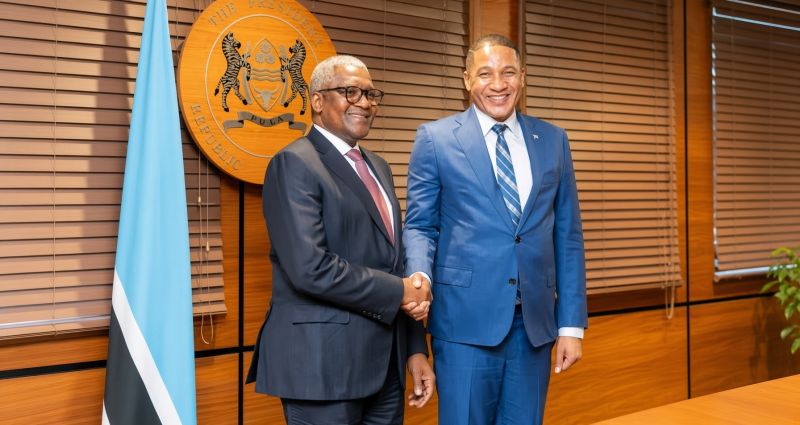
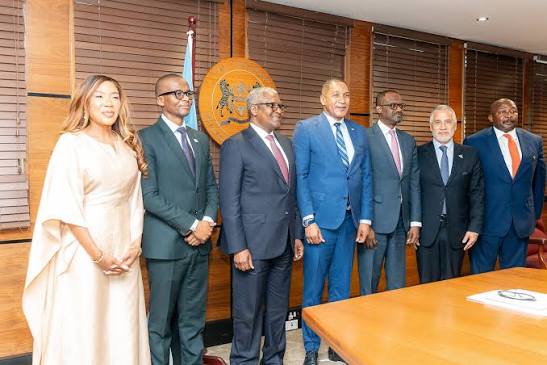
Botswana President Duma Boko met Nigerian industrialist Aliko Dangote in Gaborone on Wednesday, 2 September, urging African investors to take a more direct role in financing the continent’s development as the two sides explored large-scale infrastructure and industrial investment opportunities.
The meeting was officially described as a courtesy engagement, but it comes as Botswana and Namibia seek to move the long-delayed Trans-Kalahari Railway from years of planning towards implementation.
Boko used the meeting to make a broader appeal for African capital to finance African development. According to Botswana’s government, he told Dangote that African investors, entrepreneurs, thinkers and intellectuals had a responsibility to drive the continent’s industrial transformation and channel resources towards improving livelihoods.
“African investors, African thinkers, African intellectuals, and African entrepreneurs are responsible,” Boko said, according to the Botswana government’s DailyNews.
There was no announcement of a signed investment agreement between Botswana and Dangote following Wednesday’s meeting. Reporting on the encounter indicates that infrastructure opportunities, including the Trans-Kalahari rail project, were among the areas discussed.

The Pipeline And Rail Question
The Trans-Kalahari Railway is potentially the most important piece of infrastructure in the emerging Southern African story around Dangote.
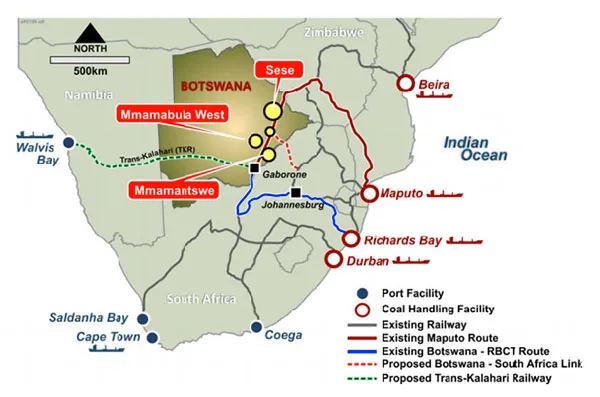
The planned heavy-haul railway would connect Botswana with Namibia’s Port of Walvis Bay, creating an Atlantic trade route for Botswana and potentially strengthening links between the port and markets further east.
The project, however, is far from being a shovel-ready railway.
Botswana and Namibia signed an agreement relating to the project in 2014, following earlier discussions, while the broader initiative dates back more than a decade. Botswana Railways says the project involves Botswana, Namibia and South Africa and is intended to establish a heavy-haul rail connection between Botswana and Namibia.
The latest feasibility work represents a significant step forward. Botswana’s Mmegi reported in August that an international consultancy had completed the feasibility study for a proposed 1500km railway, with construction targeted for 2027. The project was estimated by the publication at about US$16 billion.
But the history of the railway warrants caution.
The project has spent years moving between political commitments, feasibility studies and financing discussions without construction beginning. In 2025, Namibian and Botswana officials were still acknowledging delays, with the feasibility study itself having been held up by contractual and administrative issues.

Boko has since adopted a more forceful position. In July he said he had personally engaged Namibia’s leadership and wanted the project moved beyond discussion, while in August he said Botswana and Namibia had imposed tighter timelines on officials to remove regulatory and administrative obstacles.
That history makes the Dangote connection potentially significant, but it also highlights the central question: who will finance a railway whose capital requirement runs into tens of billions of dollars?
The answer remains unclear.
Neither Botswana nor Dangote announced at Wednesday’s meeting that the Nigerian group had committed to financing or constructing the railway. Any suggestion that the meeting has produced such a commitment would therefore go beyond the available evidence.
The Walvis Bay Energy Link
Dangote’s Southern African expansion nevertheless gives the proposed railway a wider commercial context.
In Zimbabwe, the Dangote Group and government signed a framework agreement in November 2025 covering investment interests in energy, cement, fertiliser and infrastructure. Zimbabwean presidential spokesman George Charamba said the agreement included discussion of a transnational petroleum pipeline running more than 2200km from Walvis Bay to Zimbabwe, with the line expected to reach Bulawayo and then Harare via Gweru.
Dangote himself said the proposed investment would involve hundreds of millions of dollars and could exceed US$1 billion, particularly because of the pipeline component.
This distinction matters.
The US$1 billion figure should be described as an investment commitment or agreement, rather than implying that US$1 billion in cash has already been deployed in Zimbabwe. The available reporting also does not substantiate the claim that the package is formally worth US$2 billion. That figure should therefore be removed unless the parties provide documentary evidence.
The proposed pipeline would potentially connect Dangote’s Nigerian refining operation and Namibian storage infrastructure with fuel markets in the landlocked interior.
Namibia is already part of that strategy.
The Dangote Group has been linked to a planned petroleum tank farm at Walvis Bay estimated at approximately US$140 million. Namibia’s National Planning Commission director-general, Kaire Mbuende, told The Namibian that Dangote intended to invest about that amount in the facility, while negotiations over land were continuing.
The proposed facility is also moving through Namibia’s regulatory process. Environmental documentation published in 2026 describes a proposed petroleum storage development on roughly 70 hectares at Walvis Bay and says the facility is intended to strengthen Namibia’s strategic petroleum-storage capacity and serve regional SADC markets.
That makes Walvis Bay potentially important not only as a port but as a distribution point for refined petroleum products moving into Botswana, Zimbabwe and other inland markets.
The proposed Zimbabwe pipeline and Trans-Kalahari Railway are therefore separate projects, with different sponsors and development processes. Their significance lies in the possibility that, if both eventually materialise, they could form complementary pieces of a broader Atlantic-facing logistics network.
Capital Markets Become Part Of The Strategy
Dangote’s expansion is also increasingly intersecting with African capital markets.
The Johannesburg Stock Exchange has confirmed that it is engaging with Dangote over a possible secondary listing of the Dangote Petroleum Refinery after the refinery’s planned Nigerian listing. A JSE spokesperson told Reuters that Dangote had shown a “strong intent” to bring the refinery to South Africa following its Nigerian debut.
The development is significant because it would allow South African investors and institutions to gain exposure to one of the continent’s largest industrial assets.
It also fits a wider push by Dangote to broaden African participation in his businesses. In August, Dangote Industries announced that a US$1 billion underwriting programme had been completed in preparation for the planned refinery IPO, comprising a funded US$600 million private placement and a further US$400 million underwriting commitment.
However, the JSE listing should not be confused with an investment commitment to Botswana or the Trans-Kalahari Railway. They are separate developments.
Dangote already has an established manufacturing footprint in Southern Africa. In Zambia, Dangote Cement says it has invested more than US$500 million in an integrated cement plant at Ndola, with a 1.5-million-tonne annual production capacity and a 30MW captive power plant.
The Zambia investment is therefore considerably more concrete than some of the newer proposals now being discussed elsewhere in the region.
The Bigger Bet
Dangote’s continental expansion is built around an industrial model in which African countries produce more of the goods they currently import, while regional infrastructure is used to connect factories, markets and ports.
His planned refinery expansion in East Africa illustrates the scale of that ambition.
Reuters reported in July that Dangote intends to finance a proposed 700,000-barrel-per-day refinery in Lamu, Kenya, through a combination of internal cash, bonds and proceeds from the planned refinery IPO. Site selection, soil testing and engineering work had already begun, according to Dangote’s vice-president for oil and gas.
The project’s reported cost is around US$15 billion to US$17 billion, with the upper figure widely cited in Kenyan reporting. The Star reported in July that Dangote Industries had identified Lamu as the proposed site for a US$17 billion facility.
The sheer scale of these projects raises a legitimate question about execution.
Dangote has demonstrated an ability to complete extraordinarily large industrial projects, most notably the Lagos refinery. But infrastructure corridors crossing several sovereign states introduce additional risks involving regulation, land acquisition, environmental approvals, financing, tariffs and political coordination.
The Trans-Kalahari Railway illustrates the problem. Governments have repeatedly endorsed the project, yet more than a decade after its launch it remains under development. Recent progress is encouraging, but feasibility completion is not the same thing as financial close or construction.
There is another complication in Zimbabwe.
Any future partnership involving Zimbabwean fuel-sector interests would need to be scrutinised carefully because of the country’s politically sensitive energy market. US authorities sanctioned businessman Kudakwashe Tagwirei and Sakunda Holdings in 2020, alleging that Tagwirei had used relationships with senior officials to obtain state contracts and preferential access to foreign currency. The US Treasury expanded its allegations against the network in 2024.
That history does not establish any connection between Tagwirei and Dangote’s proposed pipeline, and no reliable source located for this article establishes such a partnership. The earlier claim that an unnamed Zimbabwean billionaire was seeking to partner with Dangote has therefore been excluded rather than presented as fact.
From Factory To Regional Network
Dangote’s Southern African strategy is becoming easier to understand when viewed as a network rather than a collection of unrelated investments: a storage hub at Walvis Bay, a proposed pipeline into Zimbabwe, established cement manufacturing in Zambia, prospective access to South African capital markets and a regional railway intended to connect Botswana with the Atlantic.
But the network remains partly aspirational.
Forbes estimated Dangote’s real-time net worth at US$31.4 billion on 1 September 2026, making him Africa’s richest person, rather than the US$35 billion figure used in the earlier version of this article.
His financial capacity is considerable, but even Dangote cannot eliminate the political, regulatory and financing challenges that have historically slowed African infrastructure projects.
Boko’s meeting with Dangote is therefore best understood not as the launch of a completed Southern African mega-project, but as another sign that African governments are increasingly looking to African industrial capital to help build the infrastructure required for regional manufacturing and trade. Whether that ambition produces steel, pipelines and factories on the ground will ultimately depend less on the rhetoric surrounding industrialisation than on whether governments and investors can turn feasibility studies and framework agreements into bankable projects.