
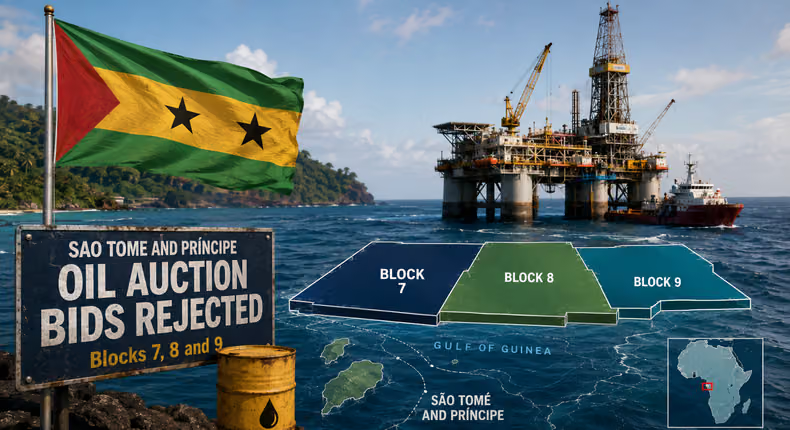


- São Tomé and Príncipe have reportedly rejected bids for three offshore oil blocks after its licensing round attracted only Petrobras and Oranto Petroleum.
- The decision came despite the Central African island nation offering investors participating interests of up to 85%.
- Its first two offshore exploration wells confirmed an active petroleum system but failed to establish commercially viable oil deposits.
- The result exposes the difficulty facing Africa’s smaller frontier markets as energy companies concentrate capital on proven discoveries and projects with faster returns.
São Tomé and Príncipe has now reportedly rejected every bid submitted in its latest licensing round, delivering another setback to the Central African country’s decades-long search for a commercially viable oil discovery.
Brazilian energy giant Petrobras and Nigerian-owned Oranto Petroleum were the only companies to submit offers for Blocks 7, 8 and 9 before the June 30 deadline, according to specialist industry publication Upstream.
The National Petroleum Agency, known as ANP-STP, reportedly decided that the bids did not provide sufficient diversity or competition to proceed with awards.
The result is a striking one for one of Africa’s smallest economies. São Tomé had offered participating interests of up to 85%, terms promoted as unusually generous for an offshore licensing round in sub-Saharan Africa.
Companies could bid for one, two or all three blocks, provided they submitted separate technical and financial proposals for each.
Yet the terms were not enough to bring a wider group of international explorers into one of Africa’s least-tested deepwater basins.
A tiny African economy chasing a transformative discovery
São Tomé and Príncipe is a two-island country in the Gulf of Guinea, off the west coast of Central Africa.
Its economy grew by an estimated 2.1% in 2025, helped by tourism, improved electricity supply and stronger agricultural exports. However, real economic output per person remained stagnant, according to the World Bank.
Tourism, cocoa and other agricultural products remain important sources of income and foreign exchange. For years, the government has viewed offshore petroleum as a possible route to larger export revenues, infrastructure investment and faster economic growth.
That makes the failed licensing round more consequential than the size of the country may suggest.

A major discovery could transform government finances. Another prolonged period without commercial success would leave São Tomé dependent on its existing, narrower economic base while neighbouring producers continue to benefit from hydrocarbons.
São Tomé’s waters are considered geologically promising because they sit in the Gulf of Guinea near established petroleum provinces, including those of Gabon and Equatorial Guinea.
But promising geology has not yet produced a bankable discovery.
Galp drilled the country’s first offshore exploration well, Jaca-1, in 2022. The well confirmed an active petroleum system but did not find a commercially viable accumulation.
Shell followed with the Falcão-1 well in Block 10 in late 2025. That campaign also gathered useful geological data but failed to establish commercial hydrocarbons.
Those results matter because deepwater exploration is expensive. Before committing hundreds of millions or potentially billions of dollars, oil companies must assess not only whether hydrocarbons are present, but whether the likely volumes can justify drilling, development infrastructure and years of operating costs.
São Tomé has established the first part of that equation. It has not yet proved the second.
Petrobras is still expanding in São Tomé
The weak auction result does not mean international companies have abandoned the country.
Petrobras completed the acquisition of a 75% operating interest in Block 3 from Oranto Petroleum on July 9. Following the transaction, Oranto retained 15%, while ANP-STP holds the remaining 10%.
Block 3 borders the acreage included in the failed round, giving both Petrobras and Oranto an existing strategic interest in the area.
Petrobras has been rebuilding its African exploration portfolio as it looks beyond Brazil for frontier basins with geological similarities to the prolific offshore fields on the opposite side of the Atlantic.
It also holds interests in other São Tomé blocks and has expanded elsewhere in Africa, including Namibia, where major discoveries have drawn some of the world’s biggest energy companies.
The contrast is important. Investors are still willing to fund African exploration, but capital is flowing most aggressively towards basins where discoveries have already reduced geological uncertainty.
Business Insider Africa