

By a Correspondent


The global diamond industry underestimated the threat posed by laboratory-grown diamonds, Anglo American chief executive Duncan Wanblad has said, as the prolonged downturn in the natural diamond market puts renewed pressure on producers and raises questions about the future of one of Africa’s most important mining sectors.
Wanblad’s comments, reported by the Financial Times, come as Anglo American continues to reassess the value and prospects of De Beers, the diamond giant it owns, amid a sharp deterioration in the market for rough stones.
The diamond industry has been hit by a combination of weak consumer demand, economic uncertainty and the rapid growth of laboratory-grown diamonds, which are chemically and physically similar to natural stones but can be produced at a fraction of the cost.
The emergence of lab-grown diamonds has disrupted a market that for decades relied heavily on the scarcity and perceived exclusivity of natural diamonds to support premium prices.
According to the Financial Times, De Beers has suffered a steep decline in valuation, while prices for rough diamonds have fallen significantly. The developments have intensified scrutiny of the company’s strategy and the broader outlook for natural diamond producers.
For Africa, the turmoil carries significant economic implications.
Countries including Botswana, Namibia, Angola, South Africa and Zimbabwe have long depended on diamond mining as a source of export earnings, government revenue, foreign currency and employment. Any sustained weakness in global diamond prices could therefore have consequences extending well beyond mining companies and investors.
Botswana is particularly exposed because diamonds have historically been the backbone of its economy, while Angola has increasingly sought to expand its diamond production as part of efforts to diversify its economy away from oil.

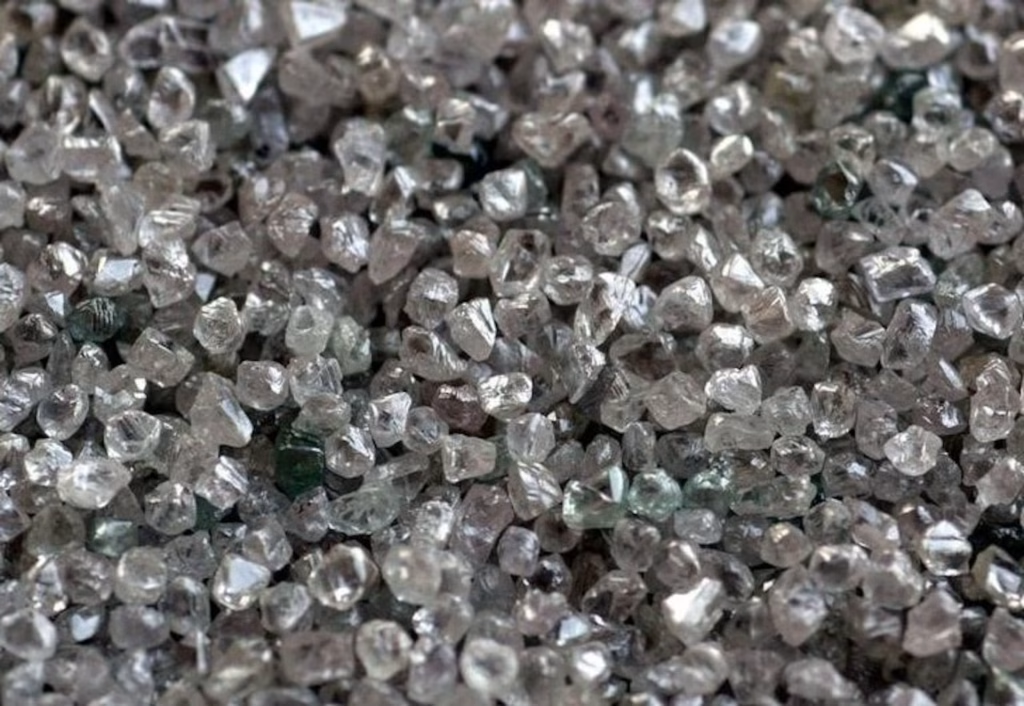
The changing market also presents a challenge to the traditional business model of the diamond industry, which has depended on controlling supply and maintaining the perception of diamonds as rare and valuable luxury goods.
Laboratory-grown stones have fundamentally altered that equation by offering consumers a cheaper alternative and forcing producers and retailers to rethink how natural diamonds are marketed.
The shift comes at a particularly difficult time for De Beers, which has struggled with weaker demand and falling rough-diamond prices. Anglo American has already moved to reduce the company’s valuation as it reviews its portfolio and considers the future of the diamond business.
The warning from Wanblad suggests that the industry’s biggest mistake may not have been simply underestimating the size of the lab-grown market, but failing to recognise how quickly consumer attitudes and technology could change the economics of diamond production.
For African producers, the disruption highlights the urgency of moving beyond reliance on the export of rough stones.
The long-term challenge is to capture more value from the diamond supply chain through cutting and polishing, jewellery manufacturing, branding and other downstream activities. This could help diamond-producing countries retain a greater share of the industry’s economic value while reducing their vulnerability to fluctuations in global rough-diamond prices.
The developments also underscore the need for African governments and mining companies to prepare for a more competitive global market in which natural diamonds can no longer rely solely on scarcity to command a premium.
While natural diamonds continue to hold a strong position in the luxury market, the rapid rise of lab-grown stones has demonstrated that consumer preferences can shift quickly when technology creates cheaper alternatives.