
By a Correspondent


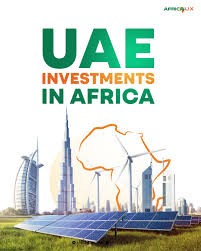
The United Arab Emirates (UAE) is rapidly expanding its economic influence across Africa through multi-billion-dollar investments in ports, mining, agriculture, logistics and renewable energy, positioning itself as one of the continent’s most influential foreign investors.
The Gulf nation has emerged as a major source of capital for African infrastructure and strategic assets, with state-backed companies pursuing deals that are reshaping trade routes and supply chains across the continent. Analysts say the investment drive is driven by the UAE’s ambition to strengthen food security, secure access to critical minerals, expand global trade networks and project geopolitical influence.
Over the past decade, Emirati companies have invested heavily in ports stretching from the Red Sea to the Atlantic coast, while expanding into mining, energy, telecommunications and large-scale agricultural projects.
State-owned logistics giant DP World has become one of Africa’s largest port operators, managing or developing terminals in countries including Senegal, Somaliland, Egypt, Mozambique and the Democratic Republic of Congo. These investments are designed to strengthen the UAE’s position as a global trading hub connecting Africa, Asia and Europe.
Beyond transport infrastructure, Emirati investors are increasing their exposure to Africa’s mineral wealth as demand grows for metals needed in electric vehicles, batteries and renewable energy technologies.

The UAE has also become a significant destination for African gold exports, while Emirati companies continue pursuing opportunities in copper, cobalt and other critical minerals.
Agriculture represents another strategic pillar of the UAE’s African expansion. With limited arable land at home, the Gulf state has sought farmland investments and food supply partnerships across East and Southern Africa to bolster long-term food security.
Renewable energy is another rapidly growing area of cooperation, with UAE-backed firms financing solar and wind projects in several African countries as governments seek to address electricity shortages while advancing clean energy goals.
For many African governments, the inflow of Emirati capital offers an alternative source of financing at a time when development funding from traditional Western partners has become more constrained. UAE investors are often seen as willing to move faster on large infrastructure projects and accept greater commercial risk.
However, analysts caution that the UAE’s expanding presence is increasingly intertwined with geopolitical competition and regional security interests.
Critics argue that commercial investments have, in some cases, overlapped with the UAE’s strategic and military objectives, particularly in the Horn of Africa and parts of the Sahel, where control of ports and logistics hubs carries significant security implications.
The growing Emirati footprint also places the UAE in competition with other major external powers—including China, Turkey and Russia—that have expanded their economic and diplomatic engagement across Africa over the past two decades.
For African policymakers, the challenge will be to maximise the benefits of foreign investment while ensuring strategic assets remain aligned with national development priorities and avoiding overdependence on any single external partner.
With Africa expected to account for a growing share of global population growth, consumer demand and critical mineral production over the coming decades, competition among foreign investors is likely to intensify, placing the continent at the centre of a new global contest for economic influence.