

By a Correspondent


MOGADISHU — Somalis living abroad are playing an increasingly important role in sustaining the country’s economy, with billions of dollars in remittances helping households, businesses and humanitarian operations amid economic and security challenges.
Data from the Central Bank of Somalia (CBS) shows that remittance inflows from Somalis abroad rose by five percent to a record US$6.78 billion in 2025, up from US$6.43 billion in 2024.
The Central Bank said the funds had become a key driver of economic stability, particularly as Somalia faces reductions in international aid.
“Remittances remained a central pillar of Somalia’s economic stability in 2025, supporting household consumption, private sector activity, and humanitarian operations,” the bank said in its 2025 annual report.
The volume of money sent home by the diaspora has also surpassed official foreign aid and humanitarian assistance, with an estimated US$5.58 billion injected annually into Somalia between 2021 and 2025.


The funds have helped sustain household consumption while providing capital for private-sector activity and supporting humanitarian operations, according to the central bank.
“Stronger individual remittances and other transfers primarily drove this growth,” the bank said.
Individual remittances increased by 15 percent to US$3.13 billion in 2025, from US$2.72 billion the previous year. The figure represented about 24 percent of Somalia’s gross domestic product, compared with 22 percent in 2024.
Individual remittances accounted for approximately 46 percent of total inward transfers, followed by business-related transfers at 36 percent and NGO-related flows at 14 percent.
The Central Bank said the overall structure of inflows remained largely unchanged, with household remittances continuing to dominate.
“The overall structure of inflows remained stable, with household remittances continuing to dominate. Commercial banks processed a significant proportion of total inflows, particularly for business and institutional transactions,” it said.
Commercial banks processed US$3.7 billion in inward transfers during 2025, representing a 12 percent increase from US$3.31 billion in 2024.
Business-related transfers accounted for the largest share of funds processed through banks, at US$1.95 billion, while individual remittances amounted to US$993 million.
Money transfer businesses also remained an important channel for diaspora funds, processing US$3.07 billion in 2025.
Of this amount, individual remittances accounted for US$2.14 billion, or about 70 percent of all transfers processed by money transfer businesses.

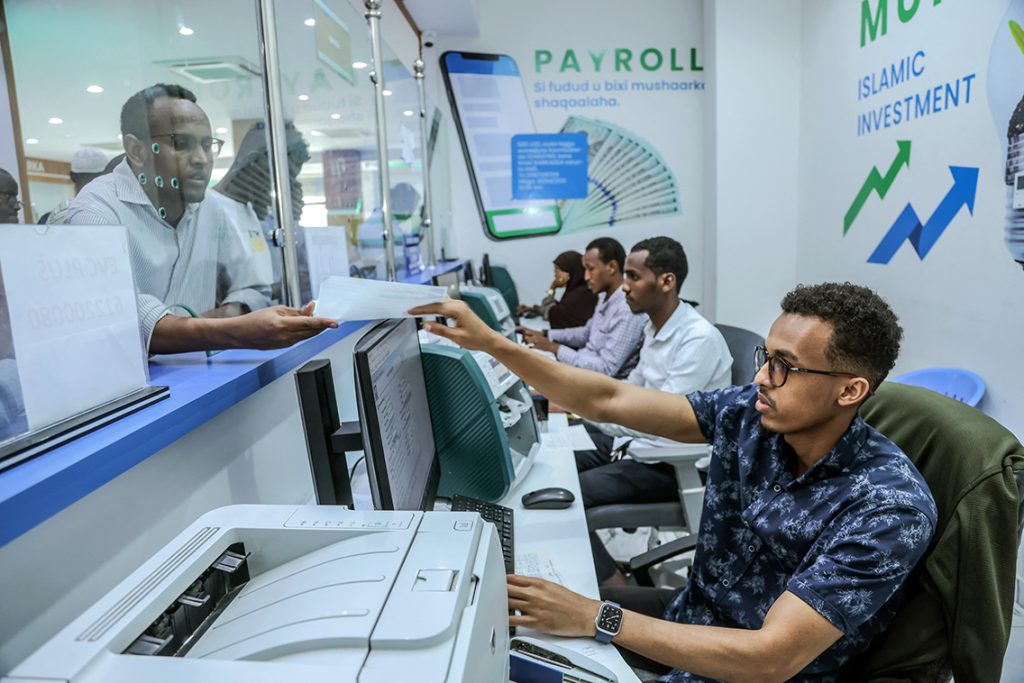
The central bank said the different financial channels played complementary roles in keeping money flowing into the country.
“The distribution of remittance inflows highlights the complementary roles of financial institutions: commercial banks facilitate most business and institutional transfers, while money transfer businesses remain the primary channel for household remittances and diaspora-linked flows,” it said.
The bank added that the inflows were important not only for individual families but also for the broader economy.
“These inflows continue to play a critical role in supporting external stability, sustaining domestic demand and underpinning foreign exchange liquidity in the economy,” the Central Bank said.
The growth in diaspora inflows comes as Somalia continues to benefit from major improvements in its debt position following international debt relief.

Somalia reached the completion point under the Enhanced Heavily Indebted Poor Countries initiative in December 2023 after more than a decade of reforms aimed at strengthening economic management, public finances and institutional capacity.
The country’s external debt fell from US$5.23 billion in 2018 to US$1.48 billion in 2025, while the external debt-to-GDP ratio dropped from 61 percent to 11 percent over the same period.
The reduction in debt vulnerabilities has created additional fiscal space for development priorities and improved Somalia’s prospects for greater integration into the international financial system.
The latest figures underline the growing importance of Somalia’s diaspora to the country’s economic resilience, particularly at a time when traditional sources of external support are under pressure.